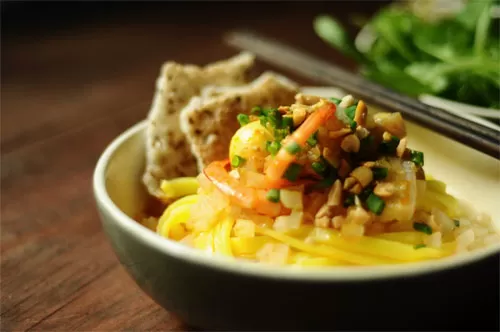
Order a mixed plate of small cakes in Hue and you might get three different ways to eat them. One arrives in little dishes and needs a spoon. Another comes flat in a leaf packet. A third may look translucent and feel almost springy when you bite it. The pleasure is in trying them one after another and noticing how the wrappers, fillings and dipping sauce change the meal.
Look for bánh bèo, bánh nậm and bánh lọc, sometimes written as bánh bột lọc. If you’re eating with someone else, order a small selection to share. You can always ask for more once you know which one you’d like to eat again.
Banh beo: Try the soft rice cake straight from its dish

Bánh bèo can arrive as a set of small dishes, each holding a shallow steamed rice cake. In Hue, savory versions often have a shrimp topping, with other garnishes varying by kitchen. Look for the contrast between the soft base and the rougher or crisper topping. Each dish gives you a small bite, so you have room to adjust the sauce on the next one.
Use the edge of your spoon to loosen the cake. Add a little of the accompanying sauce and try to lift a piece with some of the topping. If the cake sticks, work around the edge and lift it a section at a time. A spoon is easier to use than chopsticks here, especially when the cake is warm and delicate.
Taste the sauce before adding more. It may be lightly sweet, salty or hot, depending on the shop. When sharing, spoon the sauce onto your own dish if it’s served communally. Start with a small amount so you can still taste the rice and shrimp separately.
Banh nam: Open the packet and eat it from the leaf

Bánh nậm tends to come in a thin rectangular packet. Unfold the leaf carefully and you’ll find a soft, flat rice mixture, often spread with a layer of shrimp or shrimp and pork. Leave the cake on the opened leaf while you eat. The leaf gives you a surface to work from and saves you from trying to lift the whole cake at once.
Try a corner before adding sauce. Some bites contain more filling than others because the seasoning is spread across part of the surface. Use a spoon to bring a little filling and rice cake together. If the packet arrives hot, open it away from your face and give it a moment before touching the inside.
When you’re ordering for a group, ask whether the serving contains a single packet or several. Start with enough for everyone to try a bite. You can order another portion if this is the texture you like most.
Banh loc: Notice what tapioca does to the bite

Bánh bột lọc gets its characteristic chew from tapioca starch. The filling often includes shrimp and pork, though it varies by stall. Some versions come wrapped in leaves, while others are served without a wrapper. If a packet arrives, open it and eat the dumpling inside. The translucent dough can let you see the darker filling through the surface. Wikipedia’s overview of bánh bột lọc
Take a bite before dipping the whole dumpling. Its dough has more resistance than the soft rice base of bánh bèo. If it comes with a stronger sauce, try dipping just one edge first. You’ll be able to judge how much you want on the next bite.
If you’re curious about the different styles, ask whether the shop serves both bánh lọc gói, the wrapped version, and bánh lọc trần, the unwrapped version. Comparing the two in the same place lets you focus on the dough, filling and finish without changing kitchens.
Order a mixed plate and ask about the sauce
Look for the dishes on a menu or ask whether the shop offers a small mixed plate. You can point to each Vietnamese name and show how many portions you want. If one order includes several dishes or packets, check how many people it serves before adding anything else. Vietnam Travels’ Hue food guide has ideas for where these cakes fit into a wider day of eating in the city.
Shrimp, pork and fish sauce may be present in the fillings, toppings or dipping sauce. If you need to avoid an ingredient, ask about each part of the dish before ordering. A shop may have a different version available, or it may prepare everything using the same components. Don’t assume that a light-colored cake has a plain filling.
If you order a second round, repeat just one cake and see whether you notice more about it. The first tasting is about telling the dishes apart. The second can be about the temperature, the amount of topping or the flavor the leaf leaves behind.
Give each cake one bite with just a little sauce. Then go back to your favorite and eat it the way you like. By the end of a small plate, you’ll have tried three preparations and know which Vietnamese name to look for the next time you pass a shop selling them.